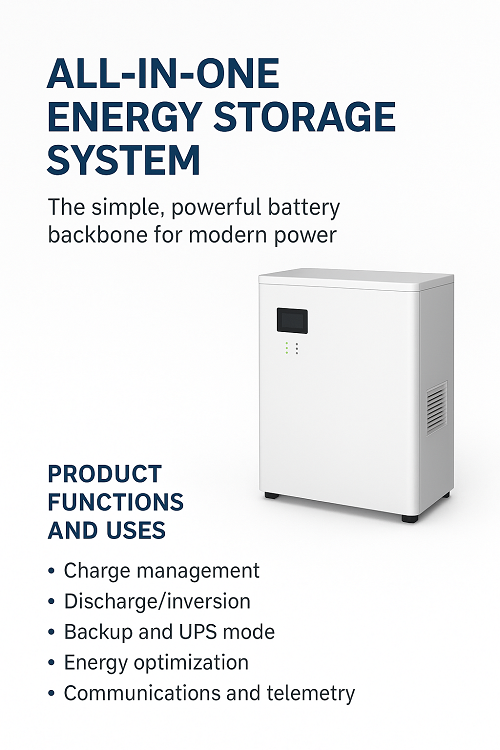
We designed the All-in-One Energy Storage System (AIO-ESS) to remove friction from energy storage: a single, compact, factory-integrated unit that combines battery modules, inverter/charger, thermal management, power distribution and smart controls so you get reliable, efficient energy storage without complex field assembly.
Product functions and uses
The AIO-ESS stores electrical energy when it is abundant or cheap (for example, from rooftop PV or grid off-peak), and delivers that energy when needed — for self-consumption, peak-shaving, backup power, grid services or off-grid operation. Its core functions are: (1) charge management (accepts DC from PV or AC from grid/generator and controls battery charging to maximize lifetime), (2) discharge/inversion (delivers stable AC power to loads with configurable priorities and seamless transfer), (3) backup and UPS mode (sub-second or configurable transfer to battery during grid failure, supporting critical circuits), (4) energy optimization (time-of-use scheduling and arbitrage using the built-in energy management controller), and (5) communications and telemetry (real-time monitoring, remote firmware updates, and open protocols for third-party EMS integration). Practically, customers use the AIO-ESS to reduce electricity bills through load shifting and peak reduction, increase PV self-consumption, guarantee uptime for medical, telecom or industrial loads, smooth intermittent generation for microgrids, and provide fast response for demand response or ancillary services.
Product features
We built the AIO-ESS with features that prioritize safety, reliability and simple commissioning. Key features include: modular LFP (LiFePO4) cells with cell-level monitoring (prevents thermal runaway and prolongs cycle life); an integrated bi-directional inverter/charger with pure sine-wave output and configurable PV/AC priorities; an active thermal management system that keeps cells within an ideal temperature window to extend life and maintain performance in −20 °C to +50 °C ambient ranges; a built-in battery management system (BMS) providing state-of-charge, state-of-health and active balancing; multi-mode operation (grid-tie, off-grid, backup/UPS, islanding with seamless reclosing); fast-acting transfer relays for zero/low-interruption backup; multiple communication layers (Ethernet, Wi-Fi, RS-485 Modbus, CAN bus, optional cellular); web and mobile dashboards with historical analytics and exportable CSV; safety hardware (AC/DC isolation, ground-fault detection, overcurrent protection, surge arrestors); and mechanical design choices such as IP54/NEMA3R enclosure options for indoor/outdoor placement and integrated handles/eyelets for simplified installation. We also include hooks for third-party EMS through open APIs so you can integrate the system into an existing microgrid or building energy management system.
Product specifications
Our standard AIO-ESS baseline model (AIO-5) and two scalable variants (AIO-10, AIO-20) cover small residential to medium commercial needs.
Typical spec summary (engineered for clarity; exact model datasheets available on request):
- Chemistry: Lithium Iron Phosphate (LiFePO4) with prismatic cells; cell redundancy and cell-level monitoring.
- Usable energy: AIO-5 — 5.0 kWh usable (5.6 kWh nominal); AIO-10 — 10.0 kWh usable (11.2 kWh nominal); AIO-20 — 20.0 kWh usable (22.4 kWh nominal).
- Nominal DC voltage: 48 V system nominal (factory configured); supports DC stacking for larger systems.
- Continuous AC power (inverter): AIO-5 — 3.5 kW; AIO-10 — 6.0 kW; AIO-20 — 10.0 kW.
- Peak / surge power (10 s): 1.8× continuous rating (e.g., AIO-10 peak 10.8 kW).
- Round-trip efficiency (DC→AC→DC measured): ≥ 90% typical.
- Cycle life: > 6,000 cycles to 80% DoD (LFP chemistry, depending on operating profile).
- Depth of discharge (configurable): up to 90% (we recommend 80% for maximum longevity unless otherwise specified).
- Operating temperature range: −20 °C to +50 °C (charging/discharging curves adjust above 45 °C).
- Storage temperature: −20 °C to +60 °C (for non-operational storage).
- Communication: Ethernet (Modbus TCP), RS-485 Modbus RTU, CAN, Wi-Fi, optional 4G/LTE.
- Protection & certifications: CE, IEC 62619/IEC 62040 (depending on options), UL compliance pathways available; AC & DC breakers, RCD/GFCI, surge protection included.
- Mechanical: AIO-5 — 650 × 450 × 300 mm, ~55 kg; AIO-10 — 800 × 500 × 400 mm, ~95 kg; AIO-20 — 1200 × 600 × 500 mm, ~180 kg. IP54 enclosure for outdoor model.
- Mounting: floor or wall (model dependent) with seismic anchors optional.
These specifications are deliberately conservative — they balance performance and lifetime. For grid-scale or uniquely constrained projects we provide performance modeling and site-specific configuration.
User manual (quick start & operation)
Safety first: always have a licensed electrician or certified installer perform AC mains and PV interconnect wiring. Unboxing: inspect the crate for damage, verify the serial number and model against the packing list, and record installation photos for warranty. Site selection: choose a dry, ventilated location, near the main distribution panel and with adequate clearances (minimum 300 mm front, 100 mm sides, 200 mm top), away from direct heat sources and corrosive environments. Mounting: secure the unit to a suitable wall or floor anchors using the included brackets; AIO-20 generally requires two installers due to weight. Electrical installation: isolate all supply sources, connect AC breaker to the distribution board with the designated breaker size consistent with the model rating, connect PV DC input to the DC combiner with proper DC fusing, and install the external AC bypass or transfer breakers if required. Commissioning: power on the unit in the order described in the manual (BMS activation, inverter standby, grid detection), connect to the local network or mobile hotspot, then register the device to your account via the mobile app or web portal using the printed activation code. Configure operation modes in the dashboard — choose priority between PV self-consumption, grid charging, time-of-use arbitrage schedules, or strict UPS mode for specific custom circuits. Routine operation: the AIO-ESS handles charge/discharge automatically per your settings and optimizes for battery health; daily monitoring is via the app with alerts for alarms. Maintenance: visual inspection every 6 months (check vents, wiring terminations, and enclosure seals), firmware updates applied remotely or via USB, and replace external fuses or the external AC breaker per local electrical code as needed. Troubleshooting: common issues (no grid detection, low PV charging) are covered in the manual with stepwise checks; more complex BMS or inverter faults report fault codes visible in the app — record the fault code and serial number and contact support. End-of-life and recycling: batteries must be recycled per local regulations; return programs are available in many regions and must be followed to comply with environmental laws. Never open the battery enclosure — internal repairs are to be done at certified service centers.
Installation and safety considerations (short practical guidance)
Because energy storage interacts with high DC voltage, grid mains and potentially backup generators, safety is non-negotiable. Our system includes mechanical and electronic interlocks, but safe installation still requires: verifying earth/ground conductor continuity, installing appropriate AC/DC breakers sized per the datasheet, ensuring the PV array open-circuit voltage does not exceed the AIO’s DC input limit, and programming anti-islanding and relay settings to match local grid-code requirements. For backup applications that require a seamless transfer to critical loads, we recommend dedicated transfer panels and pre-programmed load priorities to avoid overloading the inverter. For any generator connection, coordinate the generator inverter configuration with the AIO to avoid synchronization issues. We provide a commissioning checklist and require professional sign-off to preserve warranty.
Applicable industries
The AIO-ESS is designed to serve a broad set of industries. Residential: homeowners with rooftop PV who want backup power and lower bills. Commercial & light industrial: small retail, offices, restaurants and workshops using the system for time-of-use arbitrage, demand charge reduction and short backup outages. Telecommunications: edge-site power for cell towers and remote radio units that need reliable backup and fuel reduction. Critical facilities: medical clinics, data closet UPS support and municipal emergency shelters. EV charging sites: buffer and peak-shaving at depots or fast-charging stations to avoid expensive grid upgrades. Microgrids & rural electrification: paired with generators and PV to create hybrid power systems that reduce diesel consumption. Construction & temporary sites: transportable variants provide stable on-site power for tools and lighting. Renewable developers & EPCs: integrated into PV projects to increase capacity value and access revenue streams for ancillary services. In short, any use case that benefits from dispatchable stored energy, improved power quality and reduced operational cost is a fit.
Target customers
Our ideal customers are pragmatic energy buyers and implementers who seek a single-supplier, easy-to-deploy energy storage solution. That includes: residential early adopters and PV integrators looking for turnkey battery + inverter solutions; electrical contractors and system integrators who value modular inventory and standardized commissioning; commercial facility managers aiming to cut demand charges and guarantee continuity for selected loads; telecom operators and tower companies needing compact backup with remote telemetry; fleet operators and charging network owners reducing peak demand charges; municipalities and emergency planners who need resilient power at critical sites; and renewable project developers who want a packaged storage product that simplifies O&M and reduces BOS cost. We also sell to finance partners and aggregators who want consistent, remotely monitored assets for demand response or other grid services.
Warranty, support and product lifecycle
We pair the AIO-ESS with multi-tiered support to lower customer risk. Standard warranty covers 5 years or a specified throughput (e.g., 10 MWh for the AIO-5; model dependent), with extended warranty options up to 10 years and performance guarantees tied to cycle life. All units ship with serial numbers and cloud registration; remote diagnostics help our support engineers triage issues quickly. We publish firmware release notes with backwards-compatibility guidance and maintain a stocked parts program for service centers. For customers requiring long-term planning, we provide lifecycle modeling that translates daily use patterns into expected replacement timelines and total cost of ownership (TCO) projections.
Why choose the All-in-One ESS
Choose us if you value a solution that reduces on-site complexity: fewer field connections, a unified single-vendor warranty, simpler permitting and faster commissioning. The AIO-ESS minimizes balance-of-system materials, reduces labor time, and combines proven LFP chemistry with an inverter engineered for real-world duty cycles — all backed by remote monitoring, flexible integration options and a warranty that aligns incentives between performance and support. We design for installers, buyers and end users who want a durable, serviceable, and smart energy storage solution that starts making an impact from day one.